
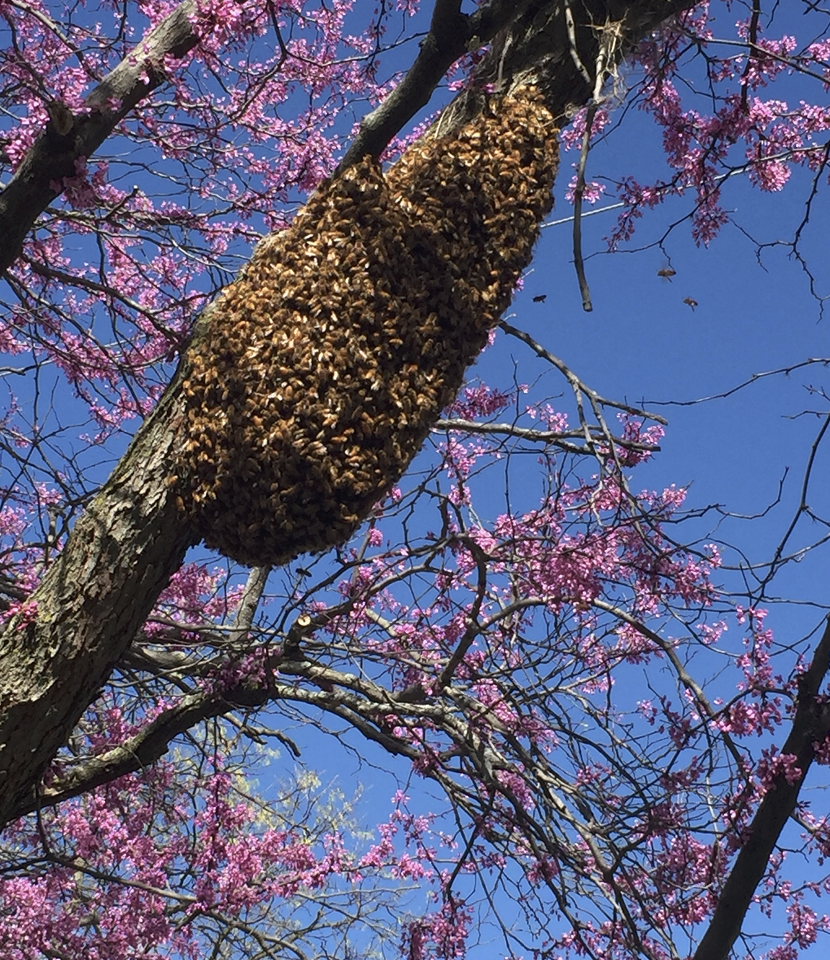
Find a swarm of honey bees? April, May, and June are the typical months.
CALL or TEXT Call 913-481-3504 or email. Thank you.
Yes, it’s best to contact someone to catch and remove. They are opportunist, looking for a new place. The process is how one colony becomes two! However, besides empty tree cavities, they could also find enough space in someone’s home or building. I’ve even found them in abandoned hot water heaters!
Looking for someone to safely re-home them without charge? Typically, beekeepers will do this catch without a fee. Try to avoid those that do! I do this as a community service. I have enough colonies. However, I work with a few organizations that need bees for various reasons.
I live in the Shawnee Mission area of Johnson County. However, I will come to all areas of the Kansas City metro. If I am not able to make it, I have contacts with other beekeepers.
CALL or TEXT Call 913-481-3504 or email. Thank you.
A few questions about the swarm…to provide a beekeeper.
- Location: Is it on a fence, bush, or low tree?
- Height: How high off the ground is it (e.g., under 15 feet is often required)?
- Size: Is it small, medium, or large?
- Duration: How long has the swarm been there?
- Accessibility: Will a ladder be necessary?
- Condition: Have you sprayed them with anything? (If yes, they may not be able to be rescued). Please don’t spray them with anything…even water!
- Have you already contacted someone else?
Important Considerations
Honey Bee Identification: Confirm they are honey bees, not yellow jackets or hornets. Safety: Do not spray with insecticides or even water, as honey bees are generally not aggressive while swarming. Phone or text: 913-481-3504 email: RBurnshoney@gmail.com. I work the Kansas City Metro Area.
Capturing a swarm is a surprisingly simple, though fascinating, process. You might be new to beekeeping and want to add a hive. Alternatively, you may be a homeowner curious about what happens when the beekeeper you’ve contacted comes to the rescue. Here’s how it works (below).
Swarms often land on a tree or shrub about head high, where they are relatively easy to catch. Sometimes they land high in a tree or along the eaves of your house. You need a ladder to catch them. We don’t recommend this unless you are extremely confident both with climbing ladders and bee-handling. Bees can swarm onto pretty much any object, weather a fence, mailbox, or your car. As long as the beekeeper can safely access them, the process of collecting them is essentially the same.
I will leave the box until dusk so that the scout bees will join the group as they return throughout the day. I dislike leaving any behind and call that ‘sloppy 2nd’s’ when I get calls to clean-up after someone else who just takes most and leaves the rest behind.
